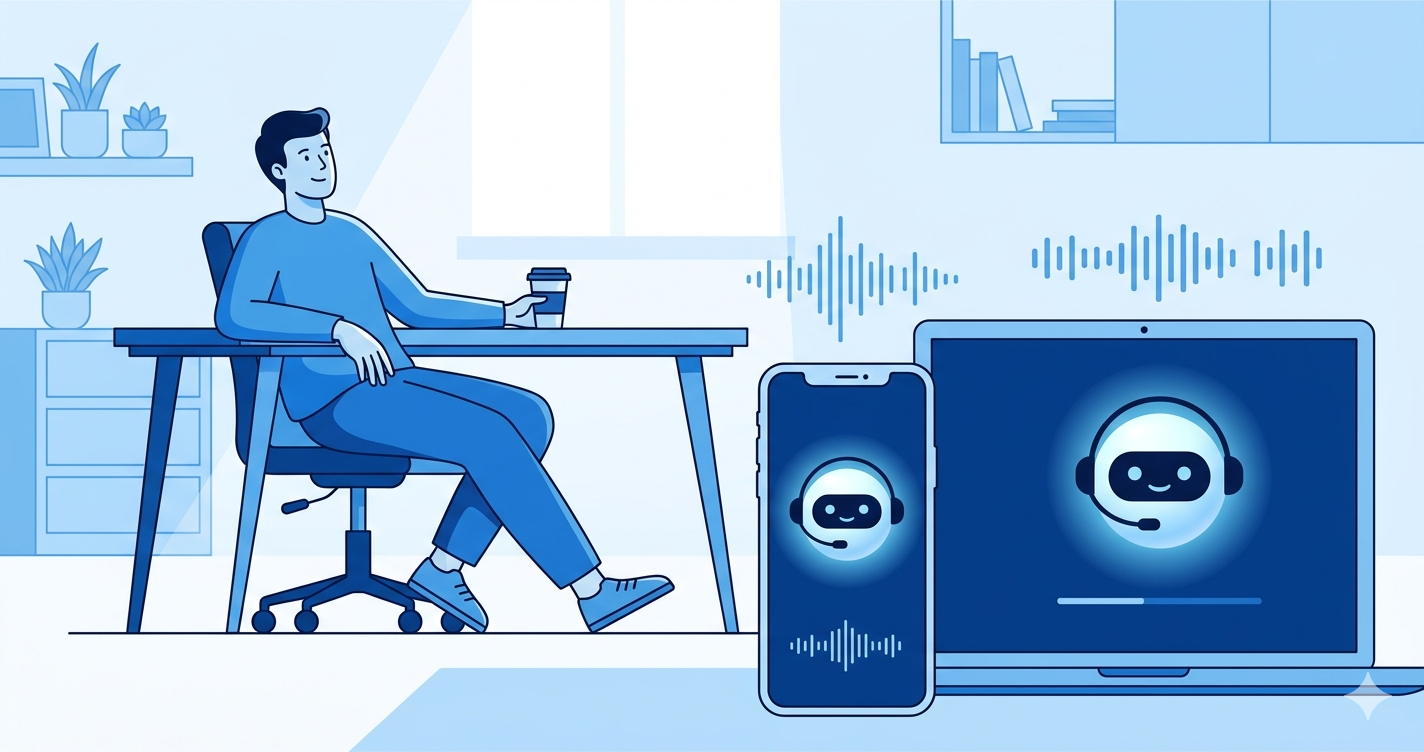
An AI assistant that makes phone calls does exactly what the name suggests: it picks up the phone, navigates the conversation, and gets the result you needed — without you being on the line. The idea sounds futuristic until you realize the technology has quietly become practical enough to handle the kinds of calls most people dread on a regular basis.
The appeal is not really about AI. It is about the call you have been putting off for four days because you do not want to sit on hold, deal with a phone tree, or go through a script designed to slow you down. An AI assistant handles all of that. You just tell it what to do.
What an AI assistant for phone calls actually does
The core function is straightforward. You provide the phone number, describe the outcome you want, and add any details the call will require — your name, account number, preferred time, or whatever is relevant. The AI places the call, speaks in natural language, listens and responds in real time, navigates hold queues and automated menus, and works toward the goal you set.
When the call ends, you get a summary: what was said, what was agreed, whether the task was completed, and whether anything needs a follow-up from you.
This is different from a voicemail or a pre-recorded message. The AI is participating in a live, two-way conversation. It can answer follow-up questions, handle unexpected prompts, respond when transferred, and adjust when the call takes a turn it did not anticipate. It does not read from a fixed script and hang up if anything deviates.
The calls it handles best
An AI assistant to make phone calls is most effective when the goal is clear and the conversation is task-focused rather than relationship-focused.
Booking appointments is a natural fit. Scheduling a dentist visit, a car service, a contractor consultation, or a restaurant reservation involves a defined outcome and a predictable conversation. The AI knows what to ask for and how to confirm it.
Cancellations work well too, and arguably they are where the assistant earns its keep most obviously. Companies that make cancellation intentionally difficult — trained retention reps, extra holds, escalating offers — are much easier to deal with when you are not the one on the line. The AI will navigate the retention script patiently and keep the call on track without getting worn down or talked into something.
Follow-up calls on existing matters — checking on a refund, confirming a delivery, asking for an update on a repair — are another strong use case. These calls often involve hold time and repetitive verification questions. None of that is a problem for an AI.
Information requests round out the list: business hours, pricing, availability, whether a prescription is ready, what documentation a service requires. Short, specific, outcome-focused.
How it compares to just making the call yourself
For a simple call to a responsive business, making it yourself is fast and there is no real friction. An AI assistant adds the most value in the situations where friction is high: long hold times, complex phone trees, calls you have been avoiding because they are unpleasant, or calls that come up during times when you cannot easily step away to talk.
There is also a phone anxiety angle that is easy to underestimate. For people who find calls genuinely stressful, the benefit of not having to be present is not just about time. It is about avoiding an experience that carries real discomfort. That is a legitimate reason to use an AI assistant, and it does not require any justification beyond the fact that it works.
The comparison to making the call yourself also changes depending on your day. If you are in the middle of focused work and remember you need to call the pharmacy, the options are: interrupt what you are doing, add it to a mental to-do list and risk forgetting, or hand it off. An AI assistant makes the third option simple.
What to look for in an AI calling assistant
The quality gap between different tools is significant, and the things that matter are not always obvious from a product description.
Real-time adaptability is the most important factor. An assistant that can only follow a fixed script will fail as soon as the call deviates — which calls do, regularly. You want a system that can handle a transferred call, an unexpected question, or a menu option that was not there last time.
Clarity of the output matters too. After the call, you need to know exactly what happened. A vague summary is not useful. You should know whether the task was completed, what was confirmed, and whether you need to do anything next.
Pricing should reflect actual use. A subscription model makes sense for businesses making hundreds of calls a month. For personal use — a few calls a month, maybe more during busy periods — pay-as-you-go is more honest. You are not going to use a flat-rate plan enough to justify the cost, and you should not have to.
Setup friction should be minimal. If configuring the assistant takes longer than making the call yourself, the whole value proposition collapses. The best tools ask for only what is necessary: the number, the task, the relevant details.
A practical example of how it fits into a real day
Say you need to cancel a gym membership, confirm that a prescription is ready for pickup, and get a quote from a plumber. Three calls. Each one is straightforward but each one has some friction — a retention script, a hold queue, a phone tag situation. Together they probably represent 45 to 90 minutes of your time if you do them yourself, and more realistically they get pushed back for days because none of them feel urgent enough to prioritize.
With an AI calling assistant, you submit all three in a few minutes, go on with your day, and check the summaries when they are done. The same outcomes, with almost none of the time cost and none of the drag.
That is what makes the technology useful in practice rather than impressive in theory. It does not require you to change how you work. It just removes a specific category of annoying task from your plate.
Is it the right tool for every call?
No, and a good AI calling assistant will not pretend otherwise. Calls that require your direct authority, involve sensitive personal decisions, or depend on a specific relationship are still yours to make. The assistant is not trying to replace human communication — it is trying to handle the parts that were never really human communication to begin with. Navigating a phone tree to cancel a streaming service is not a meaningful human experience. Letting AI handle it is just common sense.
The case for AI phone call automation comes down to a simple question: is the outcome what matters, or is the act of making the call itself important? For the vast majority of everyday admin calls, only the outcome matters. That is where an AI assistant earns its place.