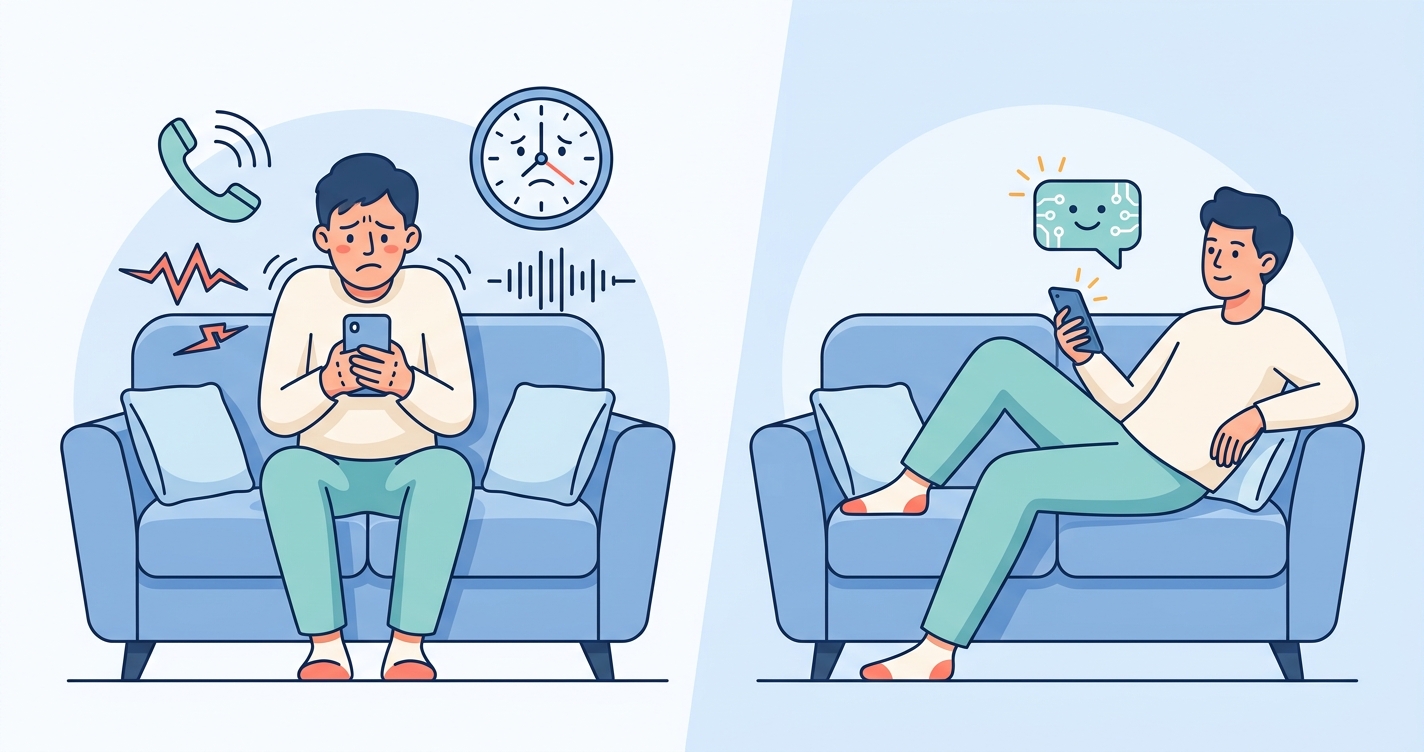
You need to make a call. You know what you need to say. The task will probably take three minutes. And yet the phone sits there while you find seventeen other things to do instead.
If this sounds familiar, you are not being dramatic and you are not alone. Phone anxiety — the dread, avoidance, and stress that surrounds phone calls — is genuinely common. It affects people who are otherwise confident, capable, and perfectly happy talking to people face to face. The phone, specifically, is its own category of difficult.
Why phone calls feel more stressful than they should
Phone calls are harder than texts or emails for a structural reason: they are synchronous and unscripted. You cannot think before you reply. You cannot re-read what you said before it leaves your mouth. You cannot see the other person's face to calibrate how the conversation is going. And you cannot easily exit the interaction once it has started.
That combination — real-time, uncontrolled, and visible — triggers the same social performance pressure that makes public speaking stressful. Your brain treats the call like an evaluation, not a transaction. Even a simple call to confirm an appointment can carry an undercurrent of worry: will I say the right thing, will they ask something I cannot answer, will I sound stupid or confused?
Add to that the specific friction of calling businesses. Hold queues stretch unpredictably. Phone trees make you repeat yourself. Representatives ask for information you did not have ready. You get transferred. You start over. By the time you reach the right person, the call has already taken longer and required more from you than it had any right to.
Who experiences phone anxiety
Phone anxiety sits on a wide spectrum. At one end is mild reluctance — the call you keep postponing because you just do not feel like dealing with it today. At the other end is something closer to a genuine avoidance pattern, where important tasks go undone for weeks because they require a phone call and the person cannot bring themselves to make it.
It is more common among people who tend toward introversion, social anxiety, or who simply grew up texting rather than talking. Younger generations, broadly speaking, have had far less practice with voice calls than older ones. A call that feels routine to someone who grew up making them regularly can feel genuinely daunting to someone for whom it is an unfamiliar format.
It also spikes in specific situations: calls to authority figures or large institutions, calls where you expect pushback (cancellations, complaints, disputes), and calls where the stakes feel higher than usual (medical offices, insurance companies, landlords). The common thread is uncertainty about how the call will go and limited ability to control it.
What does not help as much as people think
The standard advice for phone anxiety is to push through it. Make the call, feel the discomfort, and eventually it gets easier. That advice is not wrong — exposure does reduce anxiety over time for most people. But it assumes the goal is to become a confident phone caller, when for many people the actual goal is just to get the thing done.
Scripts help up to a point. Writing down what you want to say before a call reduces the risk of blanking mid-conversation. But scripts fall apart the moment the call takes an unexpected turn, which calls frequently do. The business asks a question you did not prepare for. You get transferred. The system asks you to confirm something in a way you did not anticipate. A script gives you a starting point, not a safety net.
Waiting for a better moment rarely works either. There is no ideal time to make an anxiety-inducing call. The mental load of the undone task often outweighs the anxiety of making it, but that is hard to remember when you are sitting with the phone in your hand.
What actually helps
The most direct form of phone anxiety help is removing the need to make the call yourself.
For a significant number of everyday calls — bookings, cancellations, follow-ups, information requests — the outcome matters but your personal presence on the call does not. Nobody at the doctor's office needs to hear your voice specifically to confirm an appointment. The gym does not require you personally to cancel your membership. The pharmacy does not need you on hold while they check a prescription.
These are outcome-driven calls, not relationship calls. They are also exactly the calls that tend to pile up for people with phone anxiety, because they combine low emotional value with high interaction discomfort. You do not want to do it, and there is no compelling reason you have to.
PhoneCallFor.me is built around this idea. You describe the call you need made, the AI handles it, and you get back a summary of what happened. No hold music, no awkward pauses, no performance pressure. For someone who finds calls stressful, the relief is not just practical — it is genuinely significant.
When you still need to make the call yourself
Not every call can or should be delegated. Some situations require your direct authority: disputing a charge on your own account, making a medical decision, managing a complex and emotionally sensitive conversation. In these cases, the most useful thing you can do is reduce the variables that make calls hard.
Call at a time when you are not already stressed or rushed. Have the relevant information in front of you — account numbers, dates, what you want to achieve — so you are not scrambling mid-call. Give yourself permission to ask the other person to slow down, repeat themselves, or hold while you look something up. Most people on the other end of a customer service call have heard all of this before and are not judging you for it.
If the anxiety is severe enough to consistently prevent you from handling important tasks, that is worth addressing with a therapist who works with social anxiety. The techniques that help with phone calls — gradual exposure, cognitive reframing, reducing avoidance — are well established and effective.
The case for just not making the call
There is a version of phone anxiety help that does not involve getting better at calls at all. It involves deciding which calls genuinely require you and outsourcing the rest.
Most admin calls do not need you specifically. They need a competent voice, the right information, and a clear goal. AI calling tools have reached the point where they can handle that reliably for a wide range of everyday tasks. Choosing to use them is not avoidance in the problematic sense — it is a sensible allocation of your attention and energy.
Phone anxiety is real, the friction of routine calls is real, and the mental load of procrastinating on them is real. You do not have to white-knuckle your way through every call to prove something. Getting the outcome is the point. How it happens is just logistics.